Hearing the sad news of the actor Sam Neill’s recent passing, I started thinking of one of my all-time favourite films, Jurassic Park. While (rightly) the dinosaurs got the spotlight, I found the warning of the film in a famous line delivered by Dr. Ian Malcolm (Jeff Goldblum) a pertinent reminder.
“Your scientists were so preoccupied with whether or not they could, they didn’t stop to think if they should“.

The Power of Listening
In Neuro Linguistic Programming (NLP), one of the most fundamental skills we train our practitioners in, is to listen extremely carefully. The reason, to identify language patterns which give clues about how an individual represents their version of ‘reality’ (model of the world).
Understanding an individuals’ model of the world allows us work in a very bespoke way, to enable change from the inside, by challenging hidden assumptions and beliefs. In NLP we can use the Meta Model which provides the linguistic rules of how people avoid change and assists you in helping them uncover what is really going on to move towards change.
For example, the quote illustrates the use of modal operators of probability (e.g. could, would, may, might) and modal operators of necessity (e.g. should, must, got to, have to). There is an implication that if we can do it, we must do it with little or no thought given to consequences. That is, working through what would happen if we did or what would happen if we didn’t. Of course, we all know what happens when you don’t spend the time considering the consequences, as illustrated in the film.
In Practice
During recent work coaching Senior NHS leaders and Business owners, I see this playing out consistently in high pressure or stressful environments.
We can hear it in healthcare: “If we CAN stretch capacity, we MUST.” (Generally shortened to the ask of “Can we stretch capacity?”)
We can see it in Business: “If technology CAN automate or accelerate this, we HAVE TO.” (Just think of the many examples surrounding us today)
We experience it in Leadership: “If I CAN take on extra responsibility, I SHOULD.” (Generally shortened to the ask of “Can you pick this up?”)
Notice how the ‘If’ isn’t really a choice. In high pressure contexts, in the moment probability exists, our brains treat it as a command due to so little headspace to process consequences.
Challenge ‘can’ ‘must’ language and other patterns
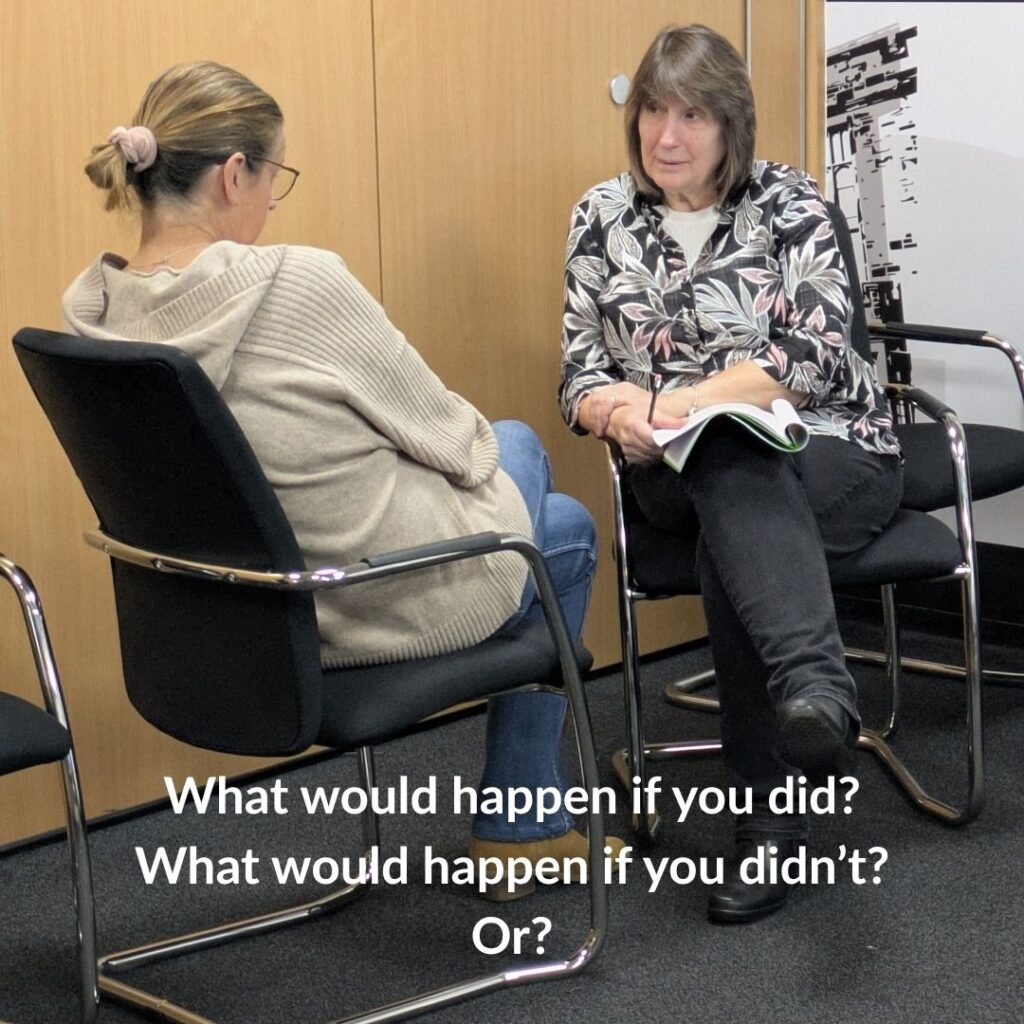
In a coaching context, it’s important when a language pattern is recognised an NLP trained coach is able to call it out and challenge the implied assumption (presupposition) appropriately.
In the example, this can be achieved by asking “What would happen if you did?” or “What would happen if you didn’t?” or simply just “Or?”. This starts to unlock creative thinking and problem solving, helping us to move forward from stuck.
The power of NLP Coaching isn’t just helping leaders improve their leadership thinking and skills. It’s creating the precious headspace, both mentally and physically, to pause, then challenge hidden presuppositions unconsciously driving the individual to move from reactive to regaining empowered conscious choice.
It’s all about the ‘L’ in NLP
When we talk or hear about NLP, there can be a tendency to focus the spotlight on skills or ‘techniques’ when often the ‘L’ – linguistic, in NLP is overlooked. This is an oversight as linguistics are a vital ingredient for making the many processes work. Learning about linguistics enables Coaches to work at another level, by being able to listen between the lines, identify language patterns and most importantly challenge them to make change, improved decisions and get results.
If you want to find out more about adding NLP to your portfolio or training as an NLP Coach get in touch and check out our training programmes.