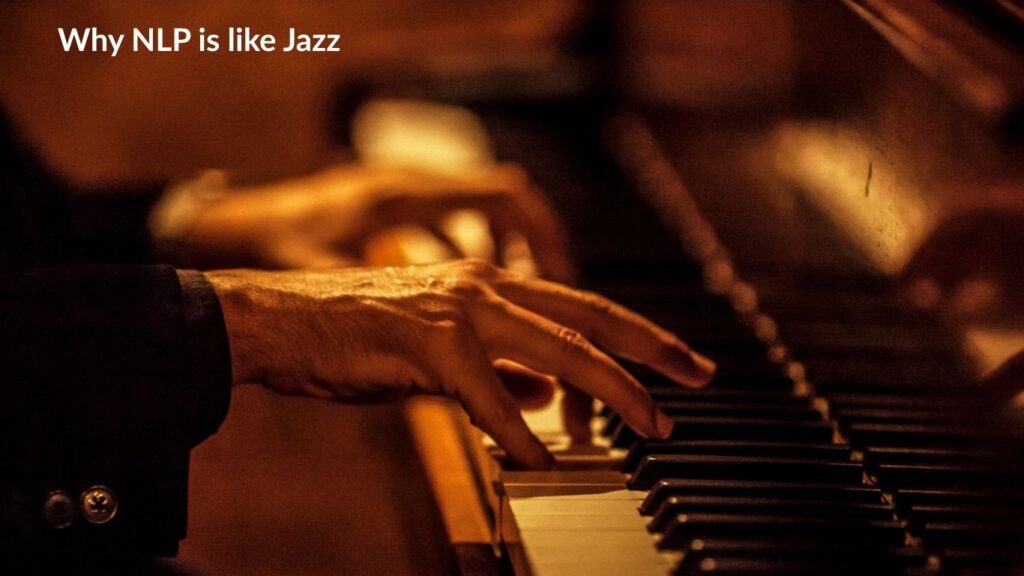
I have always had a close relationship with music, from playing various instruments to singing (in earlier years) to listening. From time to time I still sit down at the piano, though nowadays I do much more listening than playing. Whilst I’d describe my musical taste as eclectic, I have always enjoyed and been fascinated by jazz.
To me, Jazz is known for improvisation and patterns, from which a unique melody emerges, we could call that excellence. This is a great way to think about and view Neuro Linguistic Programming (NLP). NLP is about understanding patterns and processes of language and behaviour, which when brought together through natural conversation (improvisation) enables a client to break through whatever is holding them back and move forward.
As I view Jazz through an NLP lens, there are many similarities, I am going to focus on 3 key NLP areas and explore the links.
• The Map is not the Territory
• Modelling
• Sensory Acuity
The Map is not the Territory
Through the NLP Model of Communication (which I explored in my recent Supermarkets blog), we know that we all have our own unique perception, our ’map’ of reality, which is the ‘territory’.
The sheer volume of information in the world around us, is way too vast for our brains to process at once, so we create internal mental maps by filtering and deleting data. The more we update and expand these internal maps, the more flexible our thinking becomes leading to successful outcomes. This is what NLP Practitioners learn during our training.
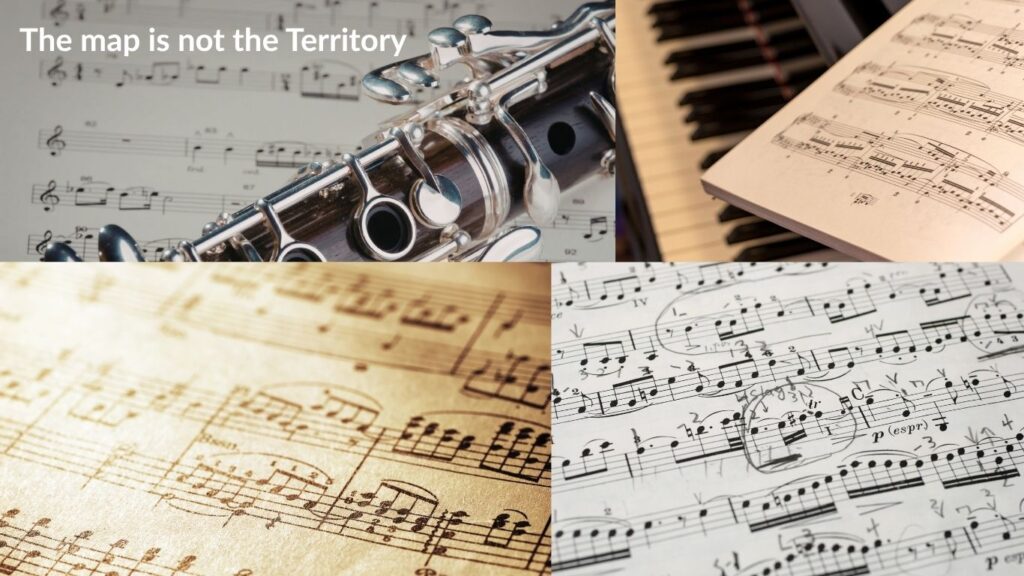
In jazz, written sheet music and chord progressions act as the musical ‘map’. It offers a shared set of rules for musicians to get together and play.
The ‘territory’, however, is the sum total of the live experience. It’s a series of moments when the individual instruments and the energy in the room connect in a completely unique performance.
That experience is also too huge to take in all at once; our personal filters ensure we take our own small piece of it away as a memory. The best musicians do use the sheet music not as a rigid script, more as a start point or tool to explore an everchanging territory, unconsciously and in the moment. Because of this, every single performance is completely different, even with the exact same map and every person will have their own personal experience.
Ultimately, written music can be seen as the map and the performance, the territory, just as our language is the map and reality is the territory.
It is well known that the great masters in Jazz don’t just ignore the rules, they improvise by knowing them (rules) so well, in order to break them to create something unique in the moment. This is similar to training as a Master Practitioner of NLP who learns the linguistic patterns, structures and processes in order to create and improvise new ones enabling clients to make change.
Modelling
On an NLP Master Practitioner course, one of the core skills you learn is the process of modelling. Simply put, it operates on the belief that “everything you can do, I can (learn to) do also.”
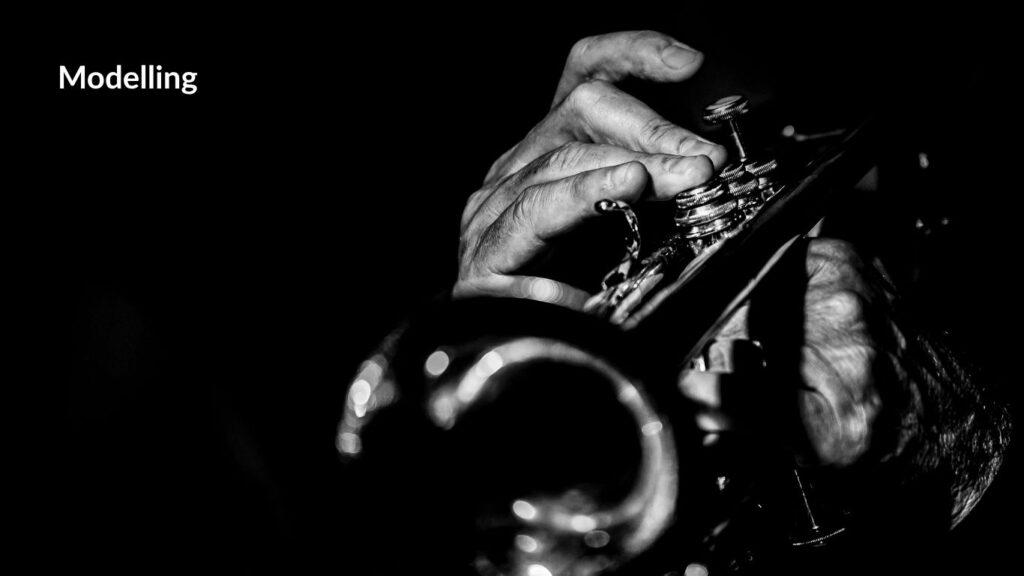
In jazz, musicians have been doing this over the years by modelling the greats, like Oscar Peterson, John Coltrane or Miles Davis (and plenty more). When you listen to a master perform, it can feel almost magical. Modelling is deconstructing that ‘magic’ into a process that anyone can follow.
Modelling goes beyond the surface. It is not just about copying a famous solo, note-for-note. It’s about studying their physiology e.g. how they breathe, how they hold themselves and move whilst playing, their thought patterns (strategies) and other mental processes. It means identifying their internal state, e.g whether they are calm, deeply relaxed, or full of energy, and installing those same patterns within yourself. To the point of integration, allowing you to eventually play your own unique version at that same level of excellence.
This is exactly how NLP was created. Richard Bandler and John Grinder the creators of NLP began by modelling exceptional communicators, therapists and thinkers such as Milton Erickson, Virginia Satir, and Fritz Perls and many more.
Instead of just looking at what those geniuses did externally, they focused on the internal. They elicited the unconscious essential mental patterns running in the background; including their self-talk, beliefs, internal representations and core values. By installing these structures, our students can move away from following a script word for word or overthinking a technique.
Instead, they can hold a highly effective and natural coaching conversation. Supporting and developing people to this level of integrated mastery is why we train Practitioners and Master Practitioners at New Perspective NLP.
Sensory Acuity
To work effectively with a client using NLP or to play great jazz, you have to start by getting into the right internal (mental) state. In NLP, we call this the ‘learning state’. It’s a powerful mix of internal resources: for example feeling grounded, open, curious, and fully present to hold space for the client. In jazz, it’s exactly the same; a musician has to be entirely present in the room, outside of their own head and in the zone.
Once in that ‘state’, you are able to employ a high level of sensory acuity. In NLP, this means using all your senses to take in the whole of a person during a coaching conversation. It allows you to notice tiny shifts in a client by picking up on subtle non-verbal cues. Things like a change in breathing, eye cues, a change in skin colour, or the tightening and relaxing of facial muscles (tonus).
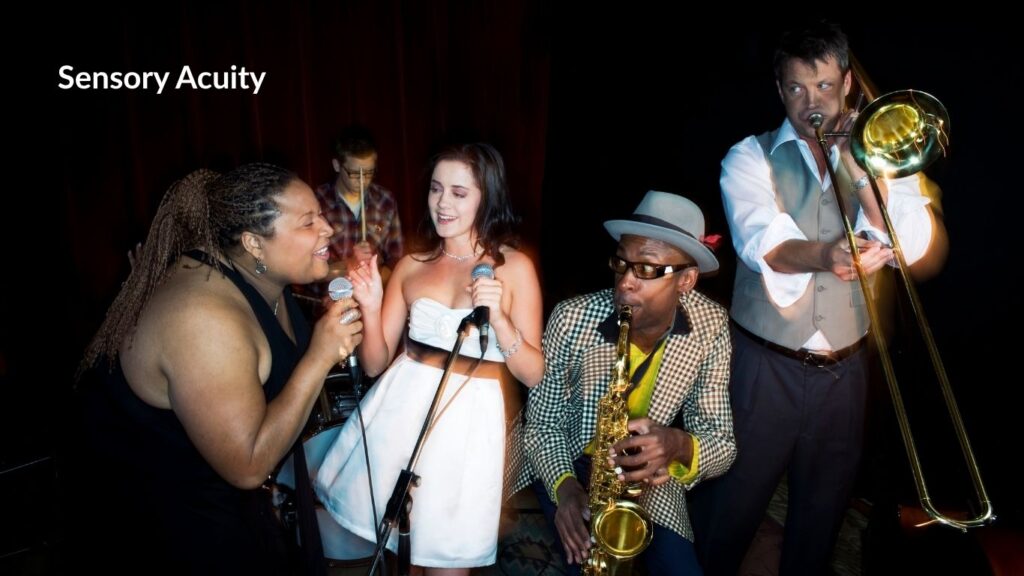
In jazz, a musician never just focuses on their own instrument or on themselves; if they do, they can quickly go off key and lose the rhythm. The best musicians constantly ‘sense’ the rest of the band, they are in tune with them. Constantly calibrating to each other whilst picking up on the energy reflecting from the audience as they adjust their own performance. (If you want an example, just watch Jools Holland lead his rhythm and blues band, his eyes are constantly scanning, as he communicates and adjusts in the moment).
So What? (no pun intended)
When we combine these elements, we can start to see communication as a form of live improvisation.
Just like learning jazz, musicians must first learn the basics (rules); chord progressions, scales and notes. At Practitioner level, NLP students do the exact same thing: they learn the core ‘rules’ of communication and language, following the processes ‘note-for-note’ to build confidence and competence.
Mastery in jazz is about absorbing those rules into muscle memory so that you can safely break them to create a unique performance. Likewise in NLP, mastery involves integrating all of the basic structures and patterns so thoroughly that you can leave scripts behind. This allows you to create something entirely unique, in the moment. It enables a level of spontaneous improvisation that feels like a piece of magic to the client, whilst delivering results
If you want to learn more about the language and rhythms of NLP to elevate your communication skills and improvise your way to excellence, get in touch to arrange a chat or explore our training pages today.