Here’s a thought and it’s something that all of us are familiar with and happens regularly which relates to NLP. You know what it’s like, going around a supermarket, clutching a trolley and wham it hits us! A huge sensory overload, how do we survive the trip? Short answer is understanding the NLP Model of Communication.
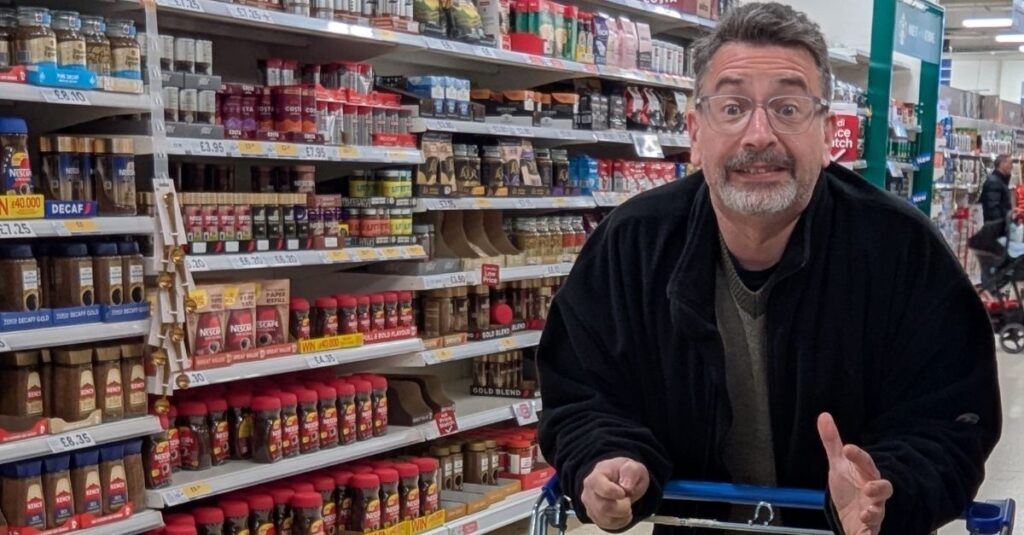
The “Infinite Supermarket”: Why We Experience Sensory Overload
Our senses are overwhelmed! It might be by the sight of aisles upon aisles of shelves of goods, as far as the eye can see, too much to handle all at once.
Or sounds like the noise of other shoppers, background muzak which can worm its way inside, announcements, shoppers on their mobiles, too much to handle all at once.
Could it be the many smells, diary, baking, pizza counter, fish, cheese?
The feeling of the fresh produce and of packaging, how do you choose the best for you? All of which are too much to handle all at once. So what do we do?
We tune out, we filter, we focus.
As we walk around, we focus on what we want to focus on, we tune out what is not of interest. Perhaps it’s the brightest eye catching display. Or maybe it’s reduced items with distinctive labels, you find yourself looking out for them after a while and it’s all you notice.
Have you tuned out the background noise and muzak yet? Perhaps you will be humming the music by the time you leave. Are you even noticing the mixture of smells or are you focused on the smells so make a beeline for the freshly baked bread ignoring other aisles?
Perhaps you have a list, and focusing on selecting just the items that are there, fighting against noticing the distractions of many offers that await you shelf by shelf, aisle, by aisle.
Perhaps you go without a list, how often do you end up with so much more?
The infinite supermarket
Navigating our day to day experience, moment to moments in life is like going around a infinitely, huge supermarket with never ending aisles and shelves stretching up to infinity with goods of every type, shape and size. There are millions of millions of bits of data which, if we took it all in, we wouldn’t be able to function, it’s way too much to handle!
Think about it like this. Our mind is full of filters, and those filters are doing an amazing job, operating out of our awareness, filtering out huge amounts of information and data to keep us sane. We simply cannot handle the enormous amount of detail as it would totally overload our senses and we wouldn’t function. Remember the aisles and shelves of goods in your local supermarket, do you take in every single item? Of course not, it’s way too much! You ignore thousands of items you don’t need in order to find the one that you do.
All those items are reduced by our personal filters who delete, distort and generalise. Leaving a tiny amount of information which we pay attention to, in the form of pictures, sounds and feelings (in our head). Then we ‘label’ them with words making them a reality. So our thoughts, as a result of that process, become our reality. Introducing, what we call in NLP, the ‘model of the world’ and everyone has their own.
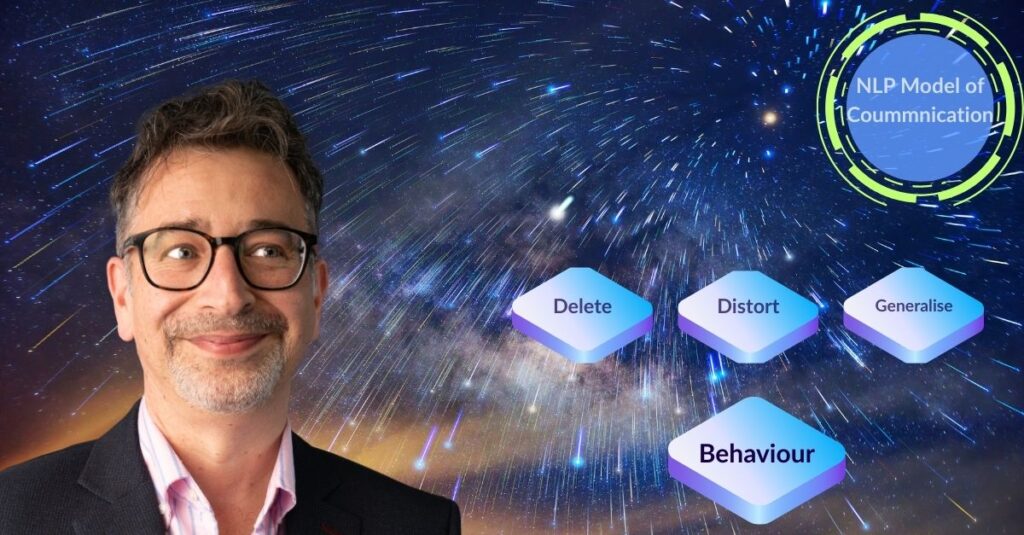
3 Primary filters from the NLP Model of Communication
The NLP Model of Communication relies on three primary filters to process information:
Delete: Ignoring irrelevant data.
The detail of the products surrounding us on the shelves and in the aisles of the supermarket are deleted out of our awareness. Notice how we only pay attention to specific items out of thousands of items that we do not pay attention to.
Distort: Misinterpreting sensory input.
In this supermarket shopping example, we might distort visually a special offer, perhaps only focusing on the price of the offer in big letters, misinterpreting the small print leading to a conclusion that it is 5 items for the price of 1 rather than 3.
Generalise: Categorising experience
This plays out as we navigate around the supermarket, categorising. We may visit the tinned aisle(s) for cans, bakery for baked goods, fresh for fruit, magical middle aisle for… well, inspiration or a ‘deal’. We generalise so that we know that tinned aisle has cans, we don’t have to relearn this every time we go. (That’s why supermarkets move goods around, meaning we have to look at new products.)
These fantastic filters along with others, are working constantly in the background, out of our awareness, in every interaction, situation and context.
Learning NLP helps us realise we are all receiving our own ‘personalised’ feed which becomes our reality (our ‘model of the world’). By increasing our awareness and understanding of this process consciously, we can make it work for us.
If you want to overcome blocks and barriers from the everyday, all the way through to pushing your limits and making the impossible, possible, then this is what you want.
Using Neuro-Linguistic Programming to Upgrade Your “Model of the World”
Let’s backtrack to begin in the supermarket; (thought…) “I need something fresh and healthy that I will feel good about…what can I get?” This is from the heavily filtered process resulting in pictures, sounds, feelings and self-talk (internal representations) about finding something fresh and healthy as you look over the fresh produce. You notice the broccoli and leeks look and feel ripe, you know that they are good for you and a decent price.
Your self-talk plays out “let’s get some as they are good for me” which links to your physiology and produces a state (how you feel). In this example feeling good within your body whilst experiencing a ‘positive’ state of improving your health and wellbeing. This leads to the output of behaviour, the act of moving the broccoli and leeks into your trolley.
This simplified process runs constantly, every day in every aspect of our lives. From something as standard as shopping to the more complex like relationships, career, education, sport and personal growth as we make choices and decisions both consciously and unconsciously. Only by becoming aware of the process, of our thoughts and how they manifest themselves into behaviours, can we gain control to make powerful and positive change.
This is where NLP adds real value, think about it as a route map to learn and understand how you function in the day to day so that you can
Improve decision making
Change limiting behaviour
Take back control
Make choice on your terms
Remember, never go shopping with a blank mind unless you want a trolley full of regret!
To learn more about NLP and how you can upgrade your mental filters, check out our training page and contact to arrange a chat or read about our students and clients successes.