On paper, you are successful. You’ve got it all. Title, wage, and a level of professional regard that others envy. So why do you feel like a fraud?
If you’ve been scrolling through the socials with their helpful algorithms, you’ve likely seen hundreds of posts telling you that you have “Imposter Syndrome.” Telling you to “be kind to yourself,” to “remember your worth,” and to “silence your inner critic.”
What about a different perspective?
Wearing an NLP hat, ‘Imposter Syndrome’ is the ‘label’ of a limiting belief. It’s origins hailing from a moment in the past where a limiting decision was made consciously or unconsciously which the owner self-perpetuates over time into a full limiting belief. Examples of these such as self-doubt, self-worth or not good enough.
Imposter phenomenon, as it was originally titled, has various definitions most commonly a combination of
Fraud, as in ‘tricking my way ‘in’ rather than competence,
Luck, “…everything just came together, somehow”, or “I don’t deserve this”, rather than hard work
Being discovered – living in fear of being found out (eg by peers, staff)
The can be linked together into a loop which plays out when faced with a new challenge or task, of over preparing or procrastinating to avoid being found out or discovered. When successful in an achievement, finding it difficult to accept praise or recognition, instead it is easier to dismiss as luck. Ever been there?

Underneath the Label
The “Tall Poppy” Trap:
In the UK we are up against it. There is a habit, embedded within our culture of self-deprecation. I remember early years in school, from the playground onwards learning to avoid ‘blowing my own trumpet’ for fear of standing out, from being a Tall Poppy. If one does, there is a tendency for the poppy to be chopped down. It is not surprising that ‘Imposter Syndrome’ is found and used so often today.
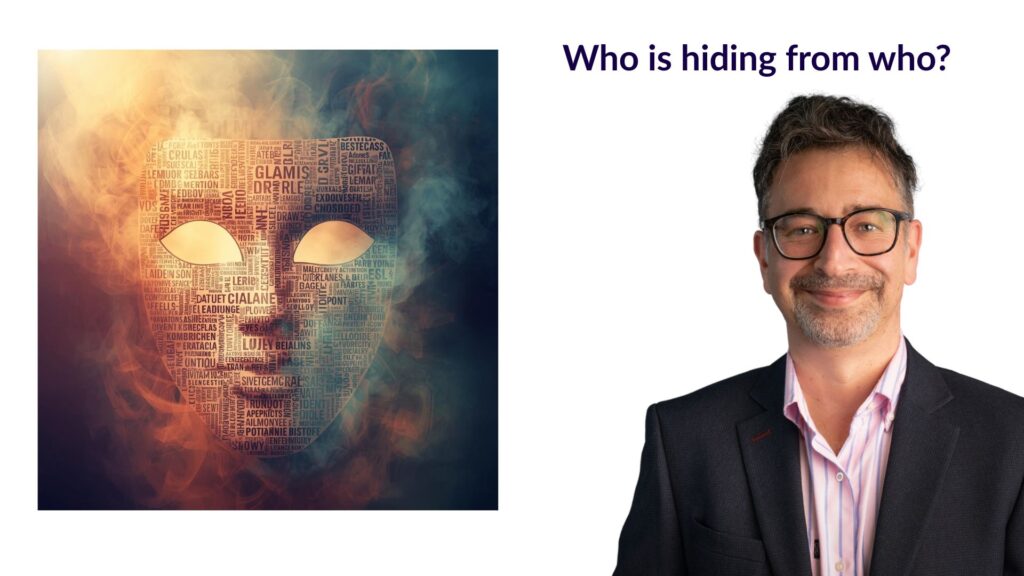
Perhaps it can be convenient to use the label of ‘imposter syndrome’ to hide behind, as a form of ‘verbal camouflage’, finding comfort?
Breaking it down
In the NLP model of communication of how we experience the world around us through a highly reduced stream of information, as soon as we label our mental map of that information it becomes a reality, to ourselves and thus behaviour changes. So when we hear language such as “I have imposter syndrome” or “I feel like an imposter…” our behaviour has changed. It is also an indication of a verbal trap.
On our NLP Training we spend valuable time on language (the ‘L’ of NLP stands for Linguistic), understanding that it is easy for us to ‘imprison’ ourselves in verbal traps by words and learning that by creating and using a different set of words, we can set ourselves free. Language is one of the most important parts of learning NLP, it is the ‘backbone’ of which every pattern and process hangs upon. That is why we train students in language at the beginning of the training.
It is important to understand what is really being said.
“I have imposter syndrome” Indicates a decision has been made.
By using label ‘decision’ this indicates it can be changed, it is not permanent.
By using ‘decision’ indicates that prior to the time of making the decision, the ‘owner’ was not experiencing the ‘limiting belief of ‘imposter syndrome’, since the decision was made, the ‘owner’ self-perpetuated it into a limiting belief, which can be held for years.
When we hear or identify a limiting belief, a suitable response to use would be “when did you decide that?” recognising that a decision was made at a point in time in the past, by the ‘owner’ of the decision and starting to raise awareness of time. Often ‘owners’ of limiting beliefs have lost conscious connection with when they made the decision, so it is as if they always had the limiting belief. This in itself can be empowering and makes a start on loosening the ‘grasp’ on the limiting belief.
Now that we know more about what imposter syndrome really is (and isn’t) and why we are identifying with it, now we can look at how we can overcome it.
Read the next part of our blog to discover ways to start working on making a difference using NLP and get some tips you can start using immediately.