In our previous blog we discussed what imposter syndrome really is and why it occurs. This follow up blog focuses on how to make a difference using Neuro Linguistic Programming (NLP) and you can access some linguistic solutions and tips to use immediately.
Take Responsibility
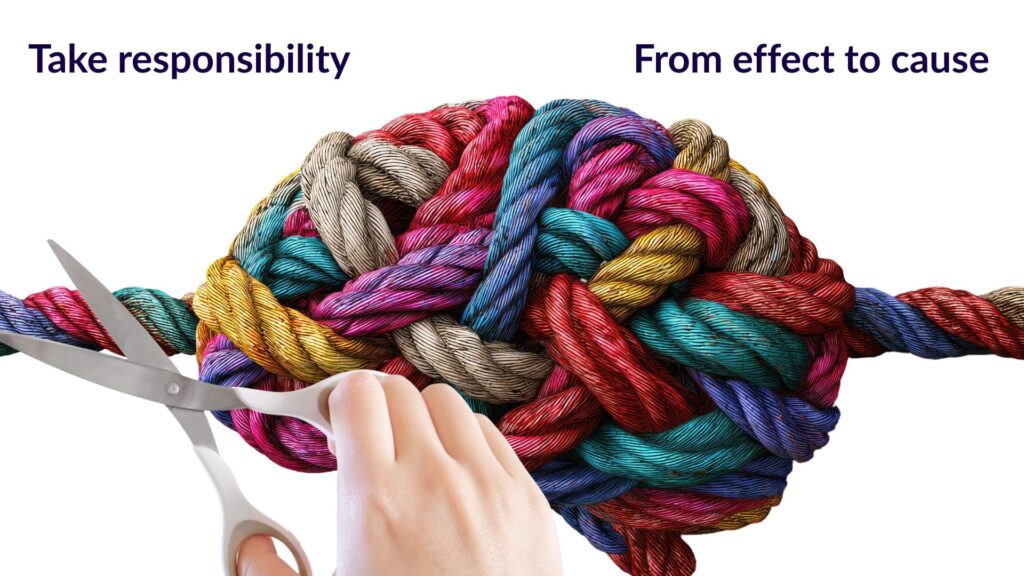
Moving from effect to being at cause
Taking responsibility is the first step forward. Are you owning your ‘label’?
When we are at ‘effect’, we surround ourselves with reasons and excuses for why life is not the way we want it. We have given our personal power to take action away from ourselves, ‘pointing’ at anyone and everyone from people, places, groups even organisations. “It is not me… its [take your pick!]…”. This is a powerless position to occupy placing self in a form of limbo. The opposite of ‘effect’ (it’s everyone else) is being at ‘cause’ (it’s me). This means that by taking responsibility for whatever happened (eg a decision or action) regardless, by doing so we are enabling ourselves to do something and take action over this. In other words empowering ourselves to move from seeking external validation to recognising (and appreciating) our own results and achievements.
First Step
In the example of Imposter Syndrome and taking action to do something about it, it may well be others who are pointed at. So, start by owning it. It is all about you! Take responsibility for yourself by understanding that you made that decision in the past. This is the first step in moving forward to freeing yourself and being at cause. If you do not take responsibility and continue to give reasons and excuses then you will remain in limbo at ‘effect’ and no-one wants that.
Skill or Will?
Moving away from the label
To start to move away from the label, we need to understand more about what sits underneath the label and how is it a problem, right now. We can call this the skill or will gap.
1. Skill (Logistical)
This is for when you do not have the technical “how-to.”
It can be a feeling: Confusion (which can be a stuck state or limbo) or lack of data.
Solution: This is not a crisis; good news, it can resolved by access or learning.
2. Will (Mental)
When you know how and what needs to be done, you are missing the ‘will’ to make it happen. This is back to tall poppy, when you need to step up, straight and tall and put yourself forward. You have all that you need to do at your fingertips, it is all about a choice of avoidance.
It can be a feeling: Boredom masked as anxiety or procrastination.
Solution: Taking responsibility by moving from effect to cause
Linguistic Solutions
To make a difference to the will gap, you need to make a change to your internal coding and think differently. NLP allows us to shift perspective so moving from being a ‘victim’ of the label to empowered ‘creator’.
1. Focus on shifting the ‘will’
Explore the negatives
Bearing in mind a choice has or is being made around avoidance of taking action, we want to help a person think differently in order to overcome the barriers and take action.
We need to pay attention to the use of words, such as ‘don’t’ and ‘not in the example of limiting beliefs. For example, “I don’t know what to do about it…It’s about not being found out..I don’t want to have this anymore…I don’t believe…”
When you hear a ‘don’t’ or ‘not’ those words are signalling that the person is focusing in the wrong direction. It is like those words act as a smokescreen blocking the way to focus on what we really want.
We want to know what a person needs to ‘do’ rather than ‘don’t’ and what they ‘are’ rather than ‘not’.
Delete ‘try’ and ‘but’
How often do you hear these two words? Our task is to remove them out of our language and replace with positive intention to combat the ‘will’.
Lets replace ‘try’ with ‘will’ or ‘do’ Try lacks commitment and intention. Remember the quote “Do or do not. There is no try” (Yoda, Star Wars). This removes the barriers to ensure action takes place.
Delete ‘but’ and replace with ‘and’. This is a way to ensure positive responsibility by removing objections, excuses (which usually precede ‘but’) and offers a positive way forward. This will take some practice and bringing conscious awareness to the frequency of the use of ‘but’ – probably much more often than the person realises.
2. Future Pace Reframe
You can use language in a reframe to shift perspective. A reframe is changing the content or context of a situation or experience. Step one, start by focusing on the ‘pain’ and consequences of everything remaining the way they are, with no change. Step two, then introduce the ‘pleasure’ of having made that change and what life will be like focusing on the positive. This will result in the mind starting to change its focus and move away from old thinking towards new thinking.
E.g. “You could just stay where you are right now, holding onto the limiting belief, in the same routine, every day watching possibilities pass you by, slowly, as you talk yourself out of each and every one. You take pride in deflecting the praise and recognition and wrap the comfort blanket round your shoulders tighter. Take a moment, just imagine 12 months from now and you are settled in a new role, things are different and so much more exciting. It’s as if you have moved from black and white into 4K high definition colour as everything is so bright! You grasp each and every opportunity, revelling in the sounds of your success and achievement. This is your ‘Loreal’ moment and yes, you know, you are worth it.

Learnings and next steps
Having taken all the steps to this point, once your focus moves from external validation to your results, the ‘imposter’ starts to go. You acknowledge and recognise your success, comfortable in the learnings that:
Confidence is not an online product! You are unable to click and collect. You do the tasks, make decisions and take responsibility to do the job. That will get you confident.
Comfort zone is a place to pass through, rather than reside. You only grow when out of the comfort zone, are you ready to make the move and start?
Close the gap from stopping waiting to be the person you already are to start being the person you are meant to be, right now.
Are you ready to own it and close your gap to be who are you are meant to be?
If you liked these hints check out more tips to download.
3 ways you can work with Rod to get results
Join an online taster of NLP to get a taster (contact me for next one) or check out our training page for details.
Enrol onto our NLP training courses delivered by myself, a Master Trainer of NLP to become an NLP Practitioner, Hypnotherapist and Coach (dates are here) or
Work 121 (contact directly).